
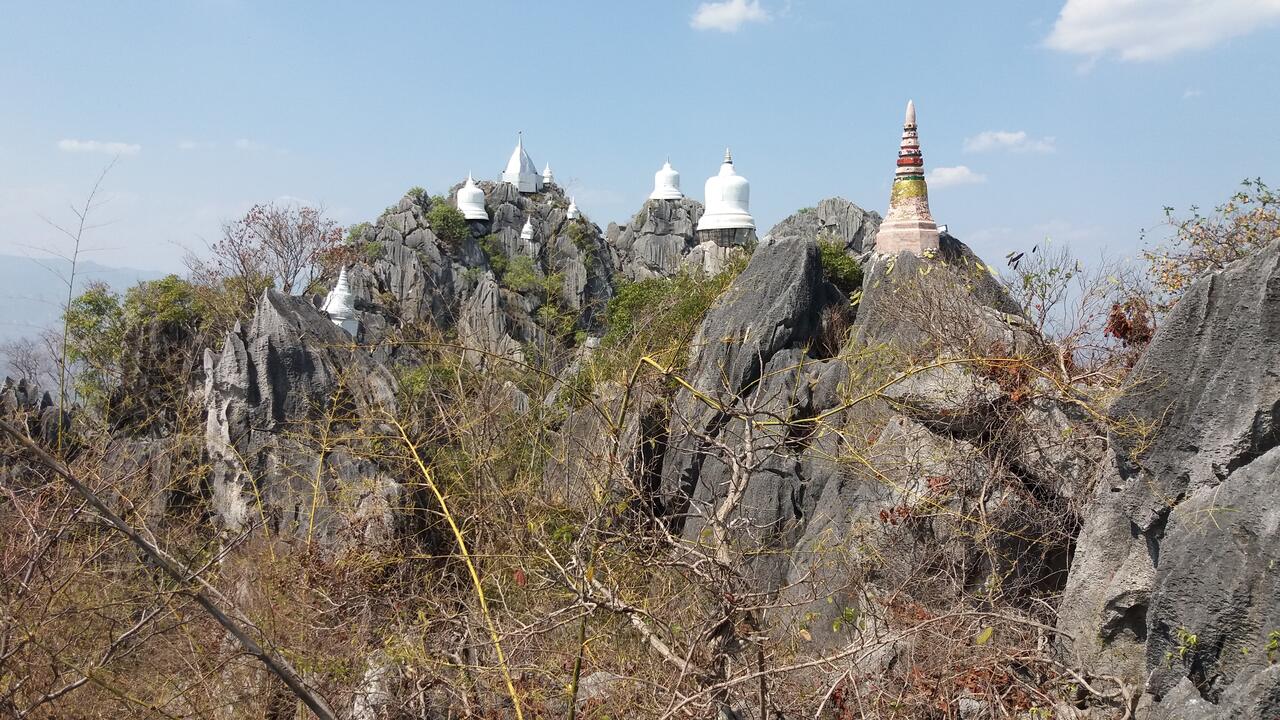
Wat Chaloem Phra Kiat is one of the most important places to visit in Lampang Province. In this region of northern Thailand, there is a mountaintop temple unlike any other. From this article, you will learn what makes it so unique, how to get there, and you will also find many interesting facts.
Wat Chaloem Phra Kiat – how was the temple created?

The site is relatively young compared to many other Buddhist religious sites in Thailand. The decision to start construction was made in 2004 by the Sangha (Assembly) on the occasion of the 200th anniversary of the birth of King Mongkut (Rama IV) – the ruler was born on October 18, 1804. Despite this, the works took over 10 years. According to the information I found, the temple was officially founded on May 31, 2010, and the construction was completed in 2015.
Previously, the area only had a Buddha footprint on Doi Pu Yak or Doi Phra Bat mountain. Additionally, in the past, there was no road leading to the peak, which made it very difficult for monks and local people to pay homage to the Buddha’s footprint. Later, Luang Pho Paiboon Sumankhalo (Phra Thep Wisutthiyan), abbot of the Analayothipayaram temple in Phayao Province, came there on a visit, and the strength of his faith became the source for the construction, which also influenced the decision of the Assembly.
Wat Chaloem Phra Kiat is also known under other names: Wat Phra Phutthabat Sotthawat, Wat Phrabat Pu Pha Daeng, or Chaloem Phra Kiat Phrachomklao Rachanusorn. Some people call it shorter – Wat Lang.
Location and most important information for visitors
Location
The temple is located in the Chae Hom District of Lampang Province, over 63 km north of Lampang City. This is the Doi Phra Bat area, which is not a wildlife hunting area.
Access
If you are planning to go to Wat Chaloem Phra Kiat, please bear in mind that there is no public transport (urban or suburban) or taxis in Lampang. Therefore, if you want to get there, the only options are a private car or a songthaew – a converted pickup truck with two rows of seats in the back. This type of vehicle is easily available in the city.
It is also close to Chiang Mai – the distance is from 107 to 150 km east, depending on the road chosen. The journey takes approximately 2.5 hours, and the travel time depends on the conditions on the routes. From Chiang Mai, it is possible to reach Wat Chaloem Phra Kiat using the services of operators organizing guided tours. The advantage in this case is that the guides speak English.
Important: It is not possible to get to the top by private or rented means of transport. There is a parking lot at the bottom, which I will call the base, and from there, after purchasing tickets, you board a vehicle that goes to the hill back and forth – the price for the ride is included in the admission cost. It is usually a songthaew that takes several people at a time. The route leads along steep roads with sharp turns for approximately 3.5 km through a wildlife reserve. For this reason, independent entry is prohibited.
Ticket prices to Wat Chaloem Phra Kiat

Admission price for adults: THB 490.
Admission price for a child: THB 280.
The initial prices at the window are 400 and 200 THB, but additional fees are added, including maintenance of the place. Final prices and other costs are in the table on the ticket counter window.
Residents of Thailand pay entry fees: 120 THB for an adult and 70 THB for a child.
Opening hours
The complex is open from Monday to Friday from 7:30 a.m. to 4:00 p.m.
On Saturdays, Sundays, and holidays, opening times vary slightly: 7:00 a.m. to 4:30 p.m.
Important info

After getting off in the upper part, there is still about 300 m of flat pavement to walk, and then there are 540 m of steep stairs to the top. For this reason, it is good to prepare yourself in good physical condition. I will also add that the most important points are at the top – it is 815 m above sea level. I can then say that it is a temple among the clouds. And you can actually feel and see it during your visit.
Generally, a trip with a child is not recommended, although I saw local people with their children climbing the stairs. If you are traveling with a child, it is worth being careful when climbing the mountain. It sometimes happens that the stairs on some sections do not have a handrail on one side because there are rocks, and the higher they go, the steeper they are. So it’s good to have eyes literally around your head.

Fortunately, there are roofed resting points with benches along the way. They are regularly spaced, which helps you take a break, especially on hot days. There are also first aid kits there, but they may be empty. For this reason, it is best to have water and a small supply of necessary items with you.
I will also mention that you should take a hat and wear comfortable shoes.
Wat Chaloem Phra Kiat – Sky Pagoda and other attractions
The temple area is divided into three levels, and on each of them you can see something interesting. It is true that the most frequently visited is the white pagoda on the top of the mountain as well as the prayer pavilion, from which you can clearly see other pagodas scattered on the nearby mountains and those at lower levels. However, it is also worth visiting other corners, but one by one.
Phra That Heavenly Pagoda

It is an object of great religious veneration. The pagoda is at the very top and is accessed by narrow stairs. This is where the holy relics are kept, and that is why this place is often visited by many people and monks paying homage. Many residents decide to come during the New Year and pray to ensure their prosperity.
The most important object of worship is the Buddha’s footprint placed on the top of the golden pagoda.
There is a small viewing point near the chedi that can accommodate several people. It offers a beautiful view of the surrounding area. For tourists, it is perfect for taking photos and videos.
Prayer pavilion

Another must-see attraction of the Wat Chaloem Phra Kiat temple complex. It is located opposite the pagoda at the same height. For a change, this small pavilion is roofed, which protects against the sun on hot days. We had the opportunity to go on such a hot day.

There are many images of Buddha in the pavilion, and the place is used by monks for morning and evening prayers.

The pagodas located on the tops of the mountains near the pavilion are clearly visible from here. Looking at them, one wonders how they managed to build them there in the first place. The topography and steep cliffs do not favor pleasant and easy construction. Therefore, builders deserve respect for their ingenuity and effort. Especially since a monk from Lampang and a group of 46 workers carried bricks, mortar, cement, and every other element to this place for 2 years.

Looking down the mountainside, you can see other pagodas. I must also mention that the pavilion is a wonderful 360° viewing point. The landscape includes the Thung Thung Valley and the Mueang Pan and Chae Hom districts. Additionally, the sleepy surroundings and the gentle sound of the wind make this experience unforgettable.
Wua Chae Hom balcony and further pavilions

Lower in the courtyard, it was also possible to admire the views thanks to this particular balcony. I will add that they are no less spectacular than those from the top. Moreover, this place is covered and shaded, which allows you to relax after climbing. There are bells of various sizes inside and outside the buildings, and there is nothing stopping you from ringing each of them.

On this level there are also pavilions with images of Buddha and saints. Additionally, on the fifteenth day of the waxing moon in the eighth lunar month (June or July of the Gregorian calendar), an event is held here to honor the Buddha’s footprint. It is during this period that Asanha Bucha begins. This is an important holiday for Buddhists because on this day the Buddha delivered his first sermon after enlightenment.
Bridge at Wat Chaloem Phra Kiat

While walking up the stairs to the top, at one point you cross an interesting bridge. It attracts attention with small country flags hanging on the railings. On the one hand, it’s a nice change from climbing stairs, allowing you to take a short walk on a flat surface. On the other hand, it’s nice to look at all these flags. And of course there are views.
Sumankhalo Cave

I mentioned earlier the abbot of the Analayothipayaram temple, who contributed to the construction of Wat Chaloem Phra Kiat. This is Paiboon Sumankhalo. This cave was built in his honor. It is located next to the parking lot, from which, after a ride, the walk to the top begins. Therefore, you can treat this attraction as the first or last stop during your visit. In our case, it turned out to be the last point of the trip when we were waiting for the transport that would take us down. There are many images of Buddha inside, and this place is also sacred to the local people.

There is also a café nearby, which means you can comfortably wait for your return transport. You can drink cold coffee, tea or have a snack. I had the pleasure of tasting the local cold tea, and it was delicious after such a trip.
Wat Chaloem Phra Kiat – one of the most important attractions of Lampang province
In fact, it is a great attraction not only of the region but of the whole of Thailand. Moreover, this place is promoted with the slogan “Unseen Thailand”, which is intended to encourage people to visit and discover new corners of the Land of Smiles. This is absolutely a great idea, as we had the opportunity to see for ourselves.
For me, an advantage is that the temple complex is not so crowded with tourists, which favors peaceful sightseeing. This allows you to fully enjoy your visit and the idyllic atmosphere there.
If anyone is planning a trip to this region of Thailand, I encourage you to visit Wat Chaloem Phra Kiat. Climbing the mountain may be demanding, but the effort will pay off many times over. After reaching the top, you forget about fatigue, and the views are extraordinary, which I can confidently assure you.
I will mention one more attraction of the province located near the temple. 25 km to the north is Chae Son National Park, which is another place worth visiting in this area. At the end of this article, I can only wish you successful travels and many unforgettable experiences 🙂
What else to visit in Lampang? I write about it ⇒ in this section.